
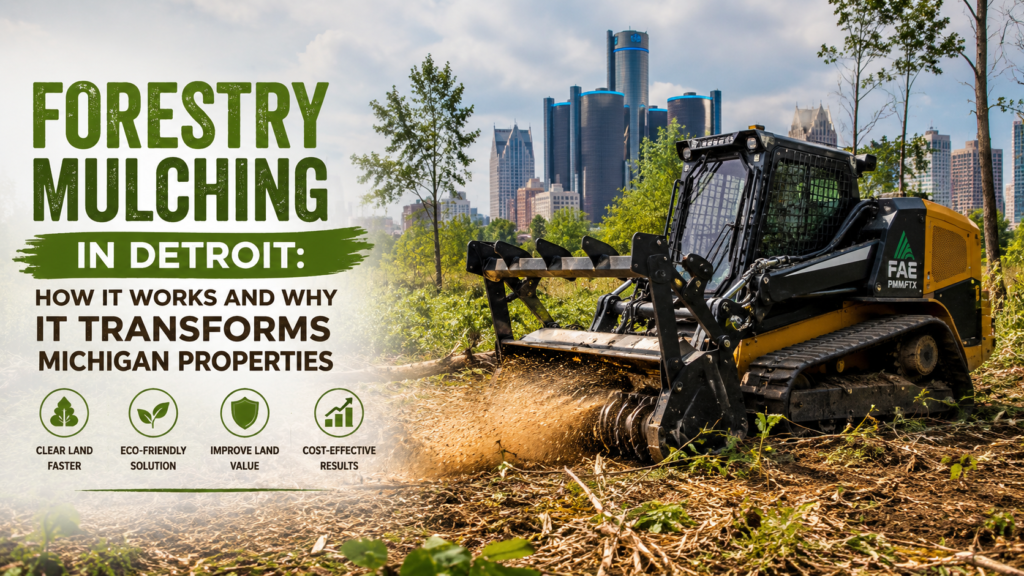
Michigan landowners, developers, and property managers in the Detroit region are increasingly turning to forestry mulching as their preferred method for land clearing. Whether clearing a vacant suburban lot, preparing acreage for construction, managing overgrown brush along fence lines, or reducing fire risk on rural parcels, Forestry Mulching Detroit has emerged as a powerful and environmentally responsible alternative to traditional clearing approaches. This guide explains exactly what forestry mulching is, how the process works, and why it has become the go-to choice for land clearing across Metro Detroit and Southeast Michigan.
What Is Forestry Mulching?
Forestry mulching is a single-pass land clearing method that uses specialized heavy equipment to grind trees, brush, shrubs, and stumps directly into a layer of fine wood chip mulch all in one operation. Unlike conventional clearing, which typically requires multiple machines working in sequence (chainsaw crews to cut, bulldozers to push, trucks to haul, and then separate stump grinders to address root systems), forestry mulching accomplishes the entire job with one piece of equipment and leaves the site clean and stable when finished.
The core piece of machinery is a forestry mulcher typically a high-horsepower tracked or wheeled carrier machine equipped with a mulching head attachment. The mulching head features a rotating drum studded with carbide steel teeth that spin at high speed. As the machine moves forward, the drum contacts trees, brush, and vegetation, grinding and shredding all organic material into fine chips that fall back to the ground in place. There is no burning, no piling, and no hauling away the resulting mulch becomes a natural ground cover on the cleared site.
How the Process Works in Michigan
In the Detroit area and broader Southeast Michigan region, forestry mulching projects follow a consistent workflow. The contractor assesses the site first evaluating vegetation density, tree species and sizes, terrain conditions, and the intended future use of the property. Michigan properties commonly feature a mix of native hardwoods like oak, maple, and cherry alongside invasive species such as Autumn Olive, Glossy Buckthorn, Phragmites, and various invasive sumac varieties that have spread widely across the state.
Forestry mulchers used in professional Michigan operations can typically handle trees up to 6 to 10 inches in diameter in a single pass, depending on the machine size and species. Larger trees may require pre-cutting with a chainsaw before the mulcher processes the stump and remaining material. The machine moves systematically across the property, grinding everything in its path. Operators work in a deliberate pattern to ensure complete coverage, with the mulched material distributing evenly across the cleared area as they work.
Michigan’s climate introduces some seasonal considerations. Forestry mulching can be performed year-round in Michigan, though winter operations on frozen ground can actually improve site conditions frozen soil supports equipment weight better, reducing ground disturbance and compaction. Dry summer conditions are also favorable for efficient mulching. Spring and fall operations are common but may involve softer soils that require additional care from experienced operators to prevent excessive ground disturbance.
What Happens to the Mulch
The material left on the ground after forestry mulching is not simply debris it functions as a productive ground cover that provides multiple benefits. The layer of wood chip mulch acts as a natural moisture-retention barrier, helping the soil beneath retain water and reducing evaporation. It protects against soil erosion, which is particularly valuable on sites with slopes or where Detroit’s spring rainfall creates erosion risk during the period between clearing and new construction or vegetation establishment.
Over time, the mulch layer naturally decomposes, returning organic matter and nutrients to the soil. This decomposition supports microbial soil health and creates conditions favorable for native plant regrowth. Studies and field experience have consistently shown that mulched areas support healthier native vegetation regrowth compared to sites cleared by bulldozing or burning, which can strip and compact the topsoil.
If the cleared land is going to be developed with a building foundation, driveway, or hardscaping the mulch layer can be removed or incorporated into the soil through grading. For sites where vegetation management is the goal rather than construction, the mulch can simply remain in place to naturally improve the land over time.
Applications in the Detroit Metro Area
Detroit and the surrounding Southeast Michigan communities present a distinctive set of land clearing applications where forestry mulching is particularly well-suited. Vacant land represents a significant category Metro Detroit has substantial inventories of vacant residential and commercial lots, many of which have been overgrown with brush and invasive species over years of non-use. Forestry mulching rapidly transforms these parcels into usable, presentable property.
Development site preparation is another major application. Before breaking ground on new residential or commercial projects throughout Wayne, Oakland, and Macomb Counties, forestry mulching can efficiently clear wooded or vegetated parcels in preparation for excavation and grading. The single-pass efficiency means less time between property acquisition and construction commencement.
Invasive species management has become a significant driver of mulching demand across Michigan. Species like Autumn Olive, Glossy Buckthorn, and Phragmites (common reed) have spread aggressively across many Michigan properties, crowding out native vegetation, altering soil chemistry, and reducing habitat value. Forestry mulching provides effective initial removal of these species, and the mulch layer can help suppress regrowth compared to simple cutting, which typically stimulates aggressive resprouting.
Trail and access road clearing, utility right-of-way maintenance, and firebreak creation are additional applications where forestry mulching’s precision and single-machine efficiency provide clear advantages over conventional clearing approaches.
Forestry Mulching vs. Traditional Clearing Methods
Understanding what makes forestry mulching different from conventional land clearing methods helps explain its growing popularity across Metro Detroit. Traditional clearing typically involves multiple separate operations and pieces of equipment: chainsaw crews to fell trees, bulldozers to push material into piles, front-end loaders to load trucks, hauling to a disposal or chipping facility, and separate stump grinders to address root systems. Each of these operations adds time, equipment mobilization costs, and site disturbance.
Open burning was historically used in Michigan to dispose of cleared vegetation, but burn permits are increasingly restricted, and open burning creates smoke and particulate pollution in populated areas. Forestry mulching eliminates the need for burning entirely by processing all vegetation in place. This is particularly important in the Detroit metro region where populated neighborhoods and environmental quality standards make burning impractical or prohibited.
From a soil health perspective, bulldozing and grading can strip and compact topsoil the most biologically active and agriculturally valuable layer of soil. Forestry mulching disturbs the soil surface minimally because the machine grinds material above ground rather than pushing it. The root systems of cleared trees and shrubs are left largely intact underground, maintaining soil structure and reducing erosion risk.
Frequently Asked Questions About Forestry Mulching in Detroit
Can forestry mulching handle stumps? Yes. The mulching head grinds stumps to a few inches below the original ground level, eliminating them as obstacles. However, if full stump and root removal is required for a construction project, additional grubbing or excavation may be needed in combination with mulching.
Does forestry mulching damage the soil? Forestry mulching is specifically recognized for its low soil disturbance compared to conventional clearing. The machine operates above ground and the mulch it creates protects the soil surface. Minimal compaction occurs on dry or frozen ground with experienced operators.
How long does forestry mulching take? On average, a professional forestry mulching crew can clear one to five acres per day, depending on vegetation density, species, and terrain. This is typically significantly faster than equivalent traditional clearing operations.
Can specific trees be preserved during mulching? Yes. Experienced operators can selectively work around trees and vegetation the property owner wants to keep, providing precise clearing that conventional bulldozing cannot match.